


A few weeks ago, in my role as Chairperson of Financial Planners of Ireland, I was honoured to join a roundtable discussion at the Department of Finance on the key changes that may arrive in the next Budget – and what they could mean for investors. Afterwards, I shared a few thoughts on LinkedIn, and the reaction was immediate. One issue kept coming up, again and again: deemed disposal.
If you’ve ever invested in Ireland, you’ve probably heard the term, usually accompanied by a groan. It frustrates investors and financial professionals alike, and at the roundtable, An Tánaiste Simon Harris acknowledged what most of us already knew: the rule is outdated and creates real barriers.
But here’s the part that worries me most. The rule is so confusing and off-putting that many people simply opt out, leaving their money in credit unions and deposit accounts instead. In this piece, I want to explain deemed disposal in plain English, and show you, with hard numbers, why letting it put you off investing is the far more expensive mistake.
What Is Deemed Disposal?
Let’s keep it simple. Imagine you put money into an investment fund with a provider like Zurich Life or Irish Life. In most countries, you pay tax once, when you sell and take your profit. In Ireland, deemed disposal means tax can apply even when you haven’t sold anything.
Exactly eight years after you invest, the Revenue Commissioners treat you as if you had cashed in – a pretend sale – and charge 38% exit tax on any growth achieved to that point. Because it’s a “dry tax” (the gain exists only on paper) investors frequently have to sell a slice of their fund, or dip into personal savings, just to pay the bill. It’s a rule that deliberately interrupts the most powerful force in investing: compound growth.
The €100,000 Question: Cash vs Equities Over Ten Years
Because of that year-eight tax hit, many Irish savers decide investing is simply too complicated and park their hard-earned wealth in a credit union or a basic deposit account, earning an interest rate so small it practically requires a microscope. Does that “safe” strategy actually save money? Let’s follow two investors, each starting with a lump sum of €100,000.
Peter wants to avoid deemed disposal entirely. He places his money in a credit union account yielding a steady 0.5% per annum. After ten years his capital grows to roughly €105,114; after 33% Deposit Interest Retention Tax on the profit, Peter walks away with about €103,426.
John takes a different path, placing his €100,000 into a globally diversified equity fund, such as the Vanguard Global Stock Index Fund. growing at an assumed to be prudent average 6% per annum. At the end of year eight, deemed disposal strikes. The fund has grown to roughly €159,384, and Revenue automatically takes a 38% slice of the profit: a tax bill of about €22,566, leaving a net amount of €136,820.
Paying that year-eight bill stings – no question. But watch what happens next. The remaining capital of roughly €136,820 stays in the market and keeps compounding for two more years. At the end of year ten, John cashes out completely, pays the final exit tax on the growth from years nine and ten, and walks away with approximately €147,300 net.
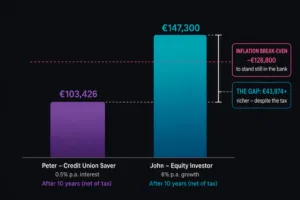
Put the two outcomes side by side and the result is stark: John finishes over €43,800 wealthier than Peter, despite paying every cent of tax the system demands. That is the hidden cost of an asset-allocation decision driven by tax avoidance.
And it gets worse for Peter, because cash carries its own silent tax: inflation. Cumulative inflation in Ireland over the past decade reached roughly 28.8%, meaning €100,000 needed to grow to nearly €128,800 just to stand still. Peter’s €103,426 is a significant loss in real terms; John’s portfolio comfortably outpaced rising living costs. Globally diversified equities continue to heavily outperform cash over long horizons, even inside the modern Irish tax framework.
Final Thoughts
Deemed disposal remains an outdated hurdle, and our team continues to lobby actively for meaningful reform at the highest levels of government. In fact, there is arguably no faster way to cut a doorstep political pitch short than asking a canvassing politician to explain the economic logic of a 38% tax on a pretend sale. If a candidate can explain why you should be penalised for long-term financial prudence without breaking eye contact, they probably deserve your vote for sheer creativity alone.
Until official changes arrive in the Budget, however, you must navigate the system as it stands, and avoiding long-term investing solely to escape an automated tax event means walking away from substantial wealth creation. Partnering with a professional advisor allows you to structure your assets efficiently and maximise your net returns. Contact Chartered Capital today to ensure your investment strategy and retirement plans are perfectly positioned for the future.
The content of this article is for information purposes only and does not constitute a personal recommendation. You should always speak to a financial adviser that is regulated by the Central Bank of Ireland when considering financial advice. Any recommendation made will be based on a full suitability assessment that will include a comprehensive review of your circumstances, needs and objectives. Past Performance Is Not A Guide To Future Returns.



In Their Own Words