
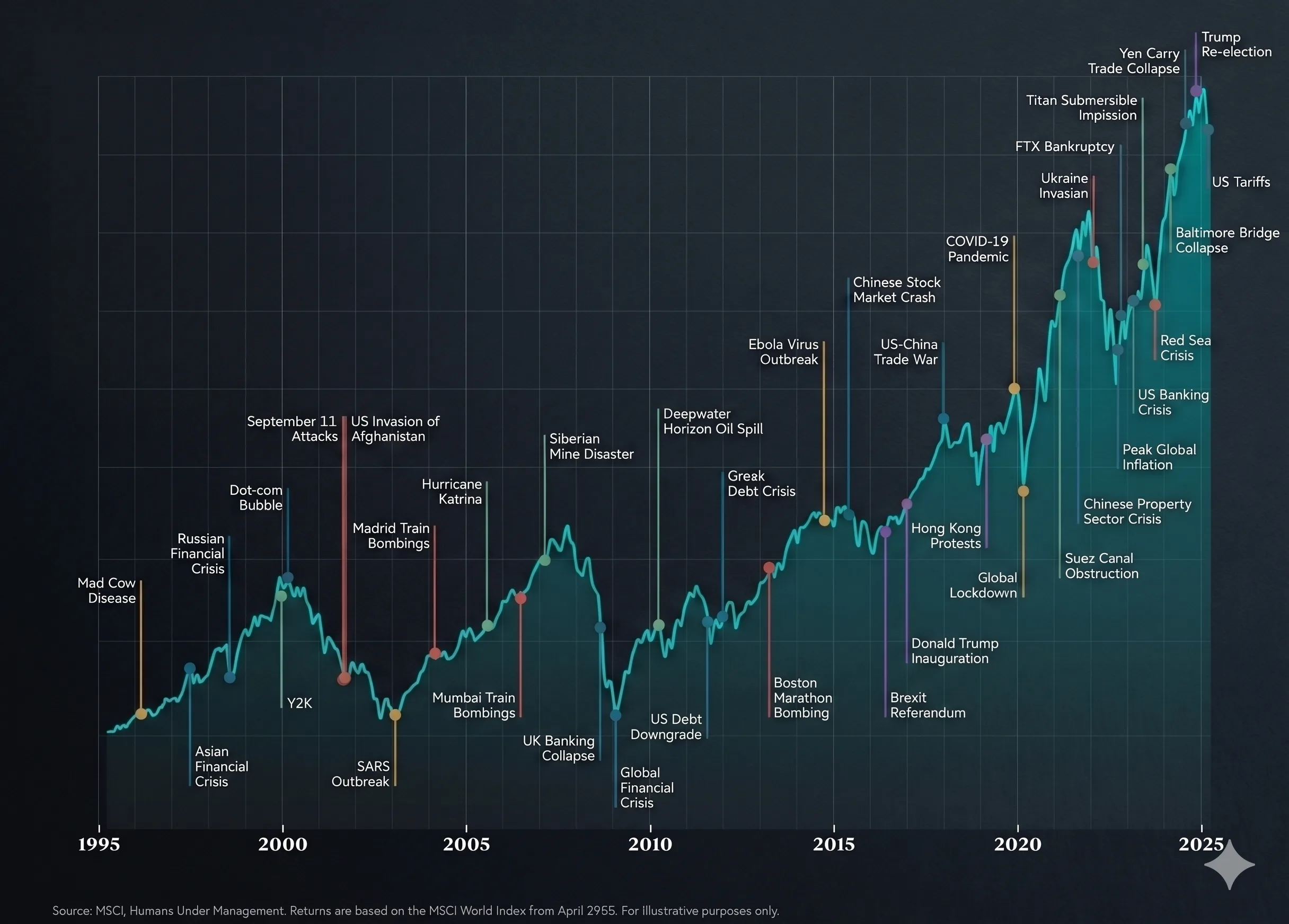
If you rely on headlines to judge how markets are performing, you could be forgiven for feeling uneasy. Conflict, political tension and economic uncertainty dominate the news cycle. Yet, at the same time, markets continue to grind higher.
This disconnect is not new. In fact, it is one of the most consistent features of investing. Bad news captures attention. Good news rarely does. Understanding this dynamic is essential for investors who want to stay focused on long term outcomes rather than short term noise.
Why Negative Headlines Dominate
Media outlets are not designed to reflect long term market progress. They are designed to attract attention. Dramatic events, political conflict and crisis driven narratives do that far more effectively than steady economic growth.
As a result, headlines tend to focus on:
- Geopolitical tensions and conflict
- Political instability and elections
- Inflation scares, rate changes or recession risks
- Market falls, not gradual recoveries
What is missing is the context. Markets price in information quickly. By the time a risk reaches the front page, investors have often already adjusted expectations.
Markets and News Move at Different Speeds
Markets are forward looking. Prices reflect expectations about earnings, growth, inflation and policy months and years ahead. Media coverage, on the other hand, is backward looking and reactive.
This explains why markets can rise while the news feels relentlessly negative.
Investors are not ignoring risk. They are weighing it against other factors such as:
- Corporate earnings and profitability
- Economic resilience and employment
- Falling or stabilising inflation
- Expected interest rate paths
When these fundamentals improve, markets can advance even while geopolitical risks remain unresolved.
Geopolitical Noise Is a Constant, Not an Exception
Every market cycle has its crisis. History is full of events that felt unprecedented at the time but barely register on long term charts.
War, political upheaval, trade disputes and financial shocks are part of the investment landscape. What changes is the headline, not the underlying reality that markets adapt and move on.
For long term investors, the key insight is this: uncertainty is always present. Waiting for it to disappear usually means waiting forever.
Why Good News Feels Underwhelming
Economic progress is often slow and incremental. Employment improves gradually. Companies grow earnings quarter by quarter. Innovation compounds over years, not days.
This kind of progress does not make for compelling headlines, but it is exactly what drives long term market returns.
Markets do not need perfect conditions to rise. They simply need conditions to be better than expected.
The Risk of Letting Headlines Drive Decisions
Reacting to news rather than fundamentals can be costly. Investors who reduce exposure during periods of heavy media pessimism often miss recoveries that happen quietly and quickly.
Some of the strongest market days historically have occurred during periods of maximum uncertainty, not calm.
This is why discipline matters more than prediction. A well structured financial plan is designed to absorb uncertainty, not avoid it.
Staying Focused When the Noise Is Loud
Successful investing is less about reacting to what you read and more about sticking to a process.
That means:
- Maintaining diversification across asset classes
- Aligning risk with your goals and time horizon
- Reviewing your plan, not your emotions, during volatile periods
- Understanding that discomfort is often the price of long term returns
The media will always find a reason to worry. Markets will continue to do what they have always done: respond to fundamentals over time.
Final Thoughts
Good news rarely sells papers, but it quietly builds wealth. Markets rising in the face of negative headlines is not a contradiction. It is a reminder that investing rewards patience, perspective and discipline.
If you are feeling unsettled by the constant stream of geopolitical noise, it may be a good time to step back and review your long term strategy. Book a confidential consultation with Chartered Capital to ensure your financial plan remains aligned with what truly matters.
The content of this article is for information purposes only and does not constitute a personal recommendation. You should always speak to a financial adviser that is regulated by the Central Bank of Ireland when considering financial advice. Any recommendation made will be based on a full suitability assessment that will include a comprehensive review of your circumstances, needs and objectives. Past Performance Is Not A Guide To Future Returns.



In Their Own Words